Hope
A cataclysmic lack of HarmonyHope is presented as a precarious inner force that survives in conditions of solitude, uncertainty, self-protective blindness, and threatened finality. It is not a settled reassurance but a fragile possibility: something held against silence, recovered through imagination, and repeatedly tested by the question of whether the end has already arrived.
Fragility and Silence
Hope first appears through the image of “Hope's fragile ropes,” a formulation that makes endurance resemble suspension over an unseen depth. The ropes are delicate rather than secure, and the surrounding world offers no reliable witness: no breathing creature “out there” could hear the inaudible utterance. Hope therefore exists at the boundary between expression and silence. It is present, but its appeal may remain unheard; its survival depends on maintaining a connection that the poem has already described as dangerously thin.
This fragile hope is bound to Solitude and acedia scratching at the heart. The state is not merely cheerful expectation but a resistance maintained under emotional erosion. Its difficulty lies precisely in the absence of confirmation. Hope does not arrive because the world answers; it persists while the answer remains inaudible.
Hope in an Uncertain World
The poem places Hope within an unstable relation to the Earth. The speaker describes living in an uncertain world and admits that feeling flummoxed is not improbable, while equanimity is identified as something needed. Hope consequently does not remove confusion or make the world predictable. It operates alongside bewilderment, paradox, and emotional contradiction: the speaker can be both flabbergasted and blasé, overwhelmed and apparently indifferent.
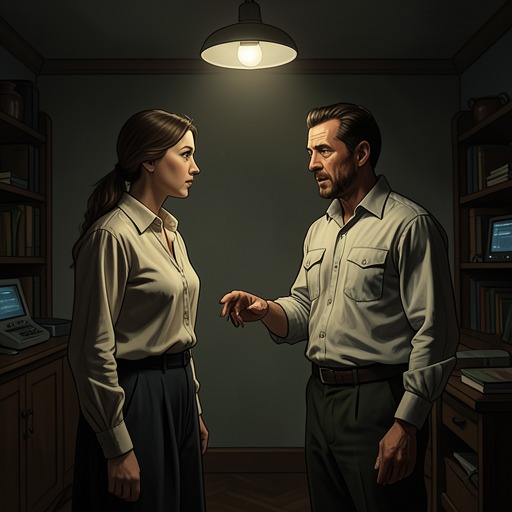
The same tension shapes the speaker’s relation to another person. What is felt for that person is called esoteric and “Not for everyone,” suggesting that hope may be carried through an intimate, difficult-to-share understanding rather than through public recognition. The possibility of a tête-à-tête, with the speaker immersed in the other person’s mind, offers a form of connection, but it remains conditional. Hope is thus relational without becoming socially expansive; the speaker explicitly states that gregariousness is not part of the self.
Imagination as Renewal
Hope gains a more luminous form through dreaming. The speaker says, “I came alive, when I was dreaming,” and links that awakening to dreaming about the Moon landing while visiting factories of stars. Imagination temporarily reverses the earlier condition of inaudibility: instead of merely holding a fragile line in darkness, the speaker becomes alive within a vision of cosmic achievement and creation.
The Moon landing is important here not simply as a subject of fantasy but as an image of possibility. It joins human aspiration to the vastness of the stars, allowing the speaker to imagine movement beyond ordinary limits. Hope does not depend on the dream being completed in the poem; its immediate consequence is renewed animation. Dreaming becomes the medium through which an apparently isolated consciousness experiences expansion.
The poem also places this imaginative renewal beside a refusal of knowledge. Innocence is said to fleet and vanish, yet the speaker refuses to turn the head, is afraid to know the truth, and pretends to be “as blind as a bat.” Hope therefore has an ethically unstable companion: self-protection. The speaker’s ability to continue may depend partly on not looking directly at what threatens that continuation. Hope is not presented as pure clarity; it can coexist with denial, fear, and the deliberate postponement of recognition.
Elemental Force and Transformation
Later, Hope is isolated through repetition: “Hope” appears twice before it is compared to something stronger than a tornado and described as a force of nature. The repetition gives the word the cadence of invocation or insistence. What was previously fragile and inaudible now acquires kinetic power. The poem does not erase its earlier vulnerability; instead, it dramatizes a transformation from a tenuous lifeline into an energy capable of carrying the speaker forward.
The associated image of a rainbow suggests direction, passage, and survival after violence. Hope becomes something one can ride, not merely something one must preserve. Yet the image retains motion rather than arrival. A rainbow offers a route through the storm, while the force of nature that produces its setting remains dangerous and uncontrollable. Hope is powerful because it moves through upheaval, not because upheaval has ended.
That power is extended by the image of lava flow painting a “colorless world.” The world is not described as merely dim but as drained of color, and Hope answers through alteration rather than consolation. Lava can destroy as well as create, so the image gives hope a troubling material force: it repaints the world by breaking its inert surface. Hope is consequently associated with active transformation, even when the transformation is violent.
Hope at the Edge of the End
The closing movement tests whether this force can survive a final crisis. The speaker feels gloomy and filled with misery, walks with the head underwater, and asks, “Is this the end?” The question converts Hope from an abstract virtue into a measure of temporal endurance. If the speaker is submerged and burdened, the issue is no longer whether the future is bright but whether a future remains imaginable at all.
The final formulation intensifies the uncertainty: “Is this the end before the end?” The phrase creates a distinction between an experienced collapse and an ultimate conclusion. Something may already feel finished while not yet being definitively over. Hope occupies precisely that interval, the narrow space in which an apparent ending can still be questioned.
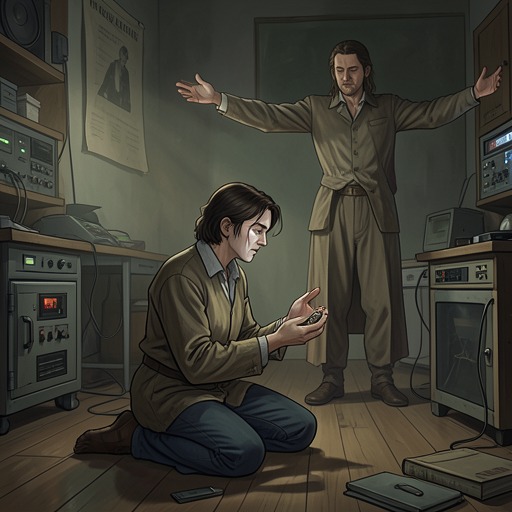
At the same time, an emptiness takes over the house, followed by repeated calls of “SOS.” The domestic interior becomes an enclosure overtaken by absence, and the distress signal makes the need for rescue explicit. Hope has not secured rescue, companionship, or certainty. Its final significance is more austere: it is the force that makes the call possible even when the house is empty, the world is underwater, and the speaker is forced to face the world alone. Through this progression, Hope remains both fragile and elemental—an inaudible thread at first, a dream of renewed life in the middle, and a last active refusal to accept that the end has already become final.